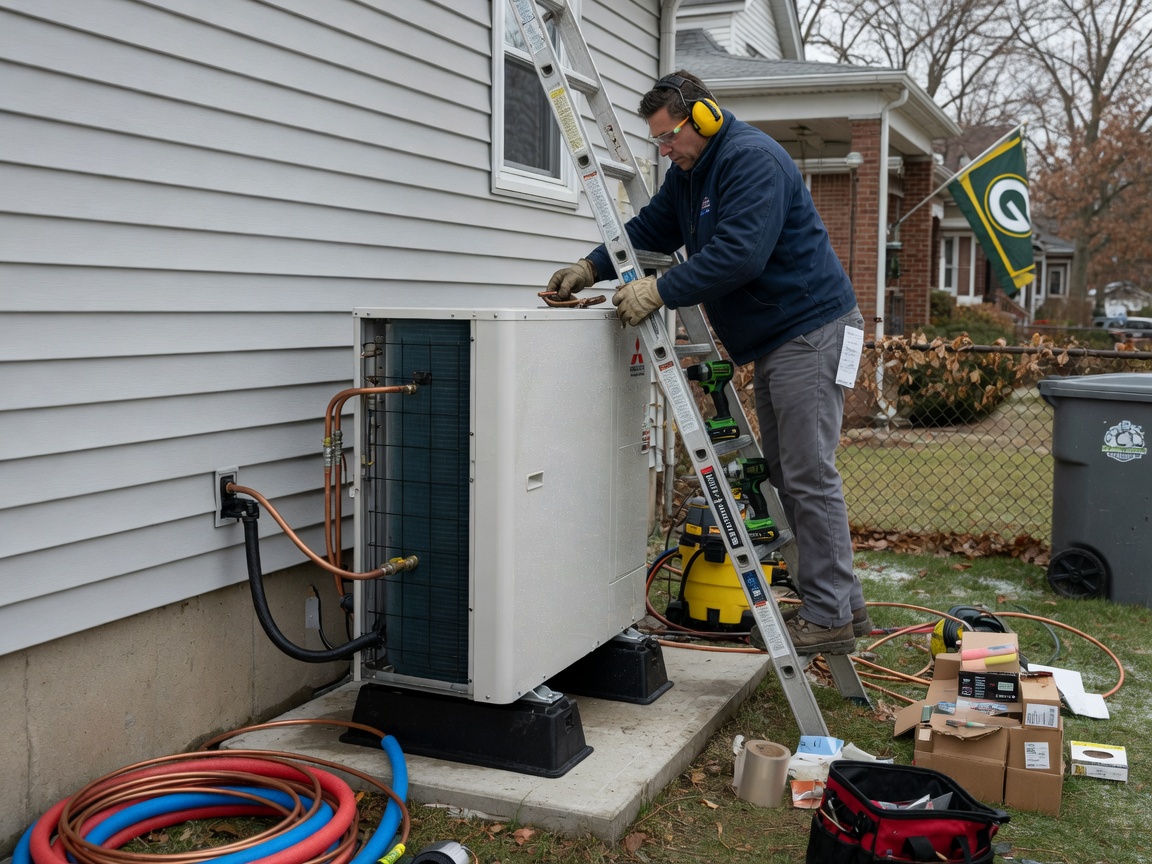
Madison homes on the East Side and Isthmus often date to the early 1900s with balloon-frame construction and limited insulation, so heat pump sizing must account for heat loss through single-pane windows and unconditioned attics before any equipment is selected. Cold snaps below zero require systems with supplemental electric or gas heat to maintain comfort without short cycling the outdoor unit in snow accumulation. Proper condensate drainage matters on the West Side where clay soils hold moisture and can freeze around linesets during January thaws.
Duct modifications in Fitchburg and Monona ranches frequently involve sealing oversized returns that leak conditioned air into crawl spaces, while Shorewood Hills and Maple Bluff properties may need outdoor unit placement screened from lake-effect winds off Lake Monona. Refrigerant line lengths and vertical lifts change efficiency in two-story Downtown buildings, and Wisconsin energy code requires proper commissioning with airflow and temperature split verification after startup. Homeowners in Sun Prairie and Verona see faster payback when existing forced-air furnaces are retained as backup rather than fully removed.
Terrain around the University of Wisconsin-Madison campus creates microclimates where afternoon shade from mature oaks reduces solar gain on south-facing coils, so outdoor units need clear southern exposure and elevated pads to clear drifting snow. Older Monona Terrace-adjacent homes often have 60-amp service panels that require upgrades before adding the larger disconnects heat pumps demand. We inspect existing duct leakage with a blower door on every job because Madison's humid summers make latent load control critical once the system switches to cooling mode.
Technician insight
In Madison the thing that catches most people out with Heat Pump Installation is underestimating how much snow drifts against outdoor units on the East Side and in Monona during lake-effect events; we always set units on 18-inch stands with clear south exposure and route condensate lines to avoid refreezing on clay soils.
East Side Bungalow Conversion
A 1928 bungalow near Olbrich Botanical Gardens had electric baseboard that struggled once temperatures dropped. We found oversized returns leaking into the uninsulated attic and a 100-amp panel. We installed a ducted cold-climate heat pump, sealed the ducts, and added a small electric backup strip. The owners now run primarily on the heat pump through most of Dane County's winter.
Heat Pump Installation Services We Offer
✓Ductless Mini-Split Heat Pump Installation
Single or multi-zone systems added to Madison homes without existing ductwork, common in Isthmus additions and older Downtown apartments.
✓Hybrid Heat Pump with Furnace Backup
Cold-climate heat pump paired with existing gas furnace for reliable operation during Dane County sub-zero periods while retaining the original heating source.
✓Whole-Home Ducted Heat Pump Replacement
Full system swap in East Side and West Side ranches where existing ductwork can be sealed and balanced for even distribution.
✓Heat Pump Installation in New Construction
Integration during builds in Fitchburg and Verona developments, coordinating with builders on equipment location and electrical service sizing.
✓Heat Pump Conversion From Electric Baseboard
Replacement of resistance heat in Maple Bluff and Shorewood Hills cottages where high electric bills make the switch to heat pump operation economical.
Heat Pump Installation Cost in Madison, WI
| Service | Typical Range | What Affects It |
|---|---|---|
| Ductless Mini-Split Installation | $3,200–$7,500 | Varies by number of zones and line-set length in older Madison homes |
| Hybrid Heat Pump With Furnace | $5,800–$10,200 | Includes furnace integration and controls on East Side and West Side properties |
| Full Ducted System Replacement | $6,500–$11,000 | Higher when duct modifications or electrical upgrades are required |
| Electrical Service Upgrade | $1,200–$2,800 | Common in pre-1970 Downtown and Isthmus homes with 60-amp panels |
Ranges are typical for Madison, WI and confirmed with an exact written quote before any work starts.
How it works
- 1
Site Assessment
We measure heat loss room-by-room, inspect existing ducts or possible line-set routes, and check electrical service capacity in the specific Madison neighborhood.
- 2
Equipment Selection
Cold-climate rated units are chosen with appropriate supplemental heat capacity for Dane County winter design temperatures and the home's insulation level.
- 3
Installation Day
Outdoor pad and lineset are run, indoor air handler or heads mounted, refrigerant lines evacuated and charged, then the system is commissioned with airflow verification.
- 4
Final Testing And Owner Walkthrough
Temperature splits, defrost cycles, and backup heat operation are confirmed before explaining thermostat settings and filter access to the homeowner.
Pricing
Upfront written quotes after on-site assessment; final price depends on home specifics and chosen equipment.